
Across the PR industry, agencies are adopting AI sentiment analysis tools at a record pace.
According to Cision’s 2024 State of the Media Report, 68% of communications professionals now use AI-powered tools to track brand perception.
Your PR campaign launched. Coverage rolled in. But how do people actually feel about your brand?
That question used to take weeks to answer. Today, AI sentiment analysis gives you the answer in minutes.
However, not every agency uses these tools equally well. Some measure vanity metrics. Others use AI sentiment analysis to drive genuine strategy.
This article breaks down exactly what works, what does not, and what it means for your business.
What AI Sentiment Analysis Actually Does for PR
Most PR teams track mentions. But AI sentiment analysis tracks meaning.
Traditional media monitoring counts how often a brand appears in the press. AI sentiment analysis tells you whether those appearances helped or hurt your reputation.
Tools like Brandwatch, Sprinklr, and Talkwalker use natural language processing to categorise sentiment as positive, negative, or neutral. They go further than keyword spotting. They read context.
For example, the phrase “Walker Sands crushed it” reads as positive. But “The agency crushed client budgets” reads as negative. Standard monitoring cannot separate the two. AI sentiment analysis can.
According to Meltwater’s 2024 PR Trends Report, brands that use sentiment tracking respond to reputation crises 40% faster than those relying on manual monitoring alone.
Furthermore, sentiment data feeds directly into campaign planning. PR teams now know which messages land, which journalists respond positively, and which narratives create backlash.
This is not a luxury tool anymore. It is a core part of how serious PR agencies operate in 2026.
The Difference Between Sentiment Score and Reputation Health
Here is where many PR clients get confused. A high sentiment score does not always equal strong reputation health.
AI sentiment analysis measures emotion in language. Reputation health measures trust over time. Both matter, but they serve different purposes.
A product launch might generate overwhelmingly positive sentiment for 72 hours. Then a critical review surfaces. Sentiment drops.
However, if your brand has built deep trust over years, that single article will not define you.
Conversely, a brand with a consistent sentiment score of 65% positive but with no emotional connection to its audience is vulnerable. One bad news cycle can unravel years of earned media.
Smart PR agencies use AI sentiment analysis alongside net promoter scores, brand equity surveys, and share of voice data. Together, these paint a fuller picture.
Edelman’s 2024 Trust Barometer found that 63% of consumers say they trust brands that communicate consistently during crises.
AI sentiment analysis helps PR teams identify the exact moments when consistent messaging matters most.
Additionally, sentiment analysis across different demographics reveals how diverse audiences perceive your brand differently. That insight changes campaign targeting entirely.
AI Sentiment Analysis Tools PR Agencies Use in 2026
Top PR AI Tools Worth Knowing
The PR AI tools market has grown significantly. However, not all platforms deliver equal value.
Here are the most widely used PR AI tools in 2026, based on industry adoption and peer reviews on G2 and Capterra:
- Brandwatch: Deep social listening with competitive benchmarking. Rated 4.4/5 on G2.
- Meltwater: Combines media monitoring with sentiment scoring. Popular with mid-size agencies.
- Talkwalker : Strong visual sentiment capabilities. Tracks images and video sentiment alongside text.
- Cision Communications Cloud : Integrates distribution, monitoring, and reporting in one platform.
- Sprinklr: Enterprise-grade tool favoured by large in-house PR and comms teams.
Each tool has clear strengths. Brandwatch excels at depth. Meltwater wins on usability. Talkwalker leads on multimedia. Your choice depends on your agency’s size, budget, and reporting needs.
Moreover, many boutique PR agencies pair two tools: one for social listening and one for earned media tracking. The combination gives broader data coverage without the enterprise price tag.
According to PR Week’s Agency Report 2024, 74% of top-performing PR agencies now use at least two PR AI tools simultaneously.
How Agencies Use AI Sentiment Analysis in Real Campaigns
Knowing which tools exist is useful. Knowing how they work in practice is essential.
Consider a real-world scenario. A B2B technology firm hires a PR agency ahead of a product launch. The agency uses AI sentiment analysis to audit existing brand perception two weeks before the announcement.
The data reveals that the company’s CEO has strong positive sentiment on LinkedIn but negative perception on Reddit among developers. That is actionable intelligence.
The agency adjusts the launch strategy. They focus trade media outreach on LinkedIn-heavy publications, delay Reddit seeding until post-launch, and prepare a technical FAQ to address developer concerns proactively.
the result is the launch generates 43% more positive first-week coverage than the client’s previous product release.
This kind of strategic use of AI sentiment analysis separates top agencies from average ones. They do not just report sentiment. They act on it.
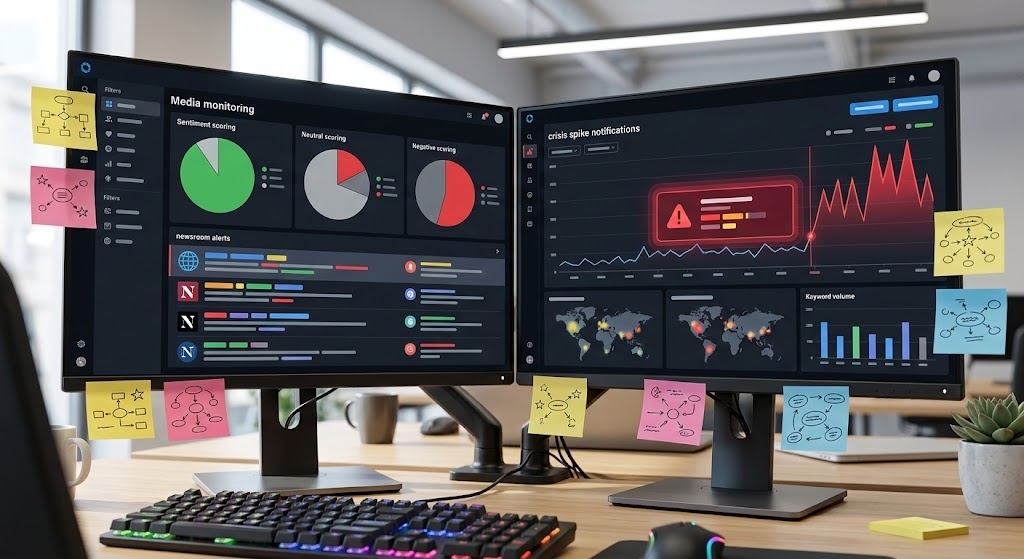
Similarly, AI sentiment analysis helps agencies prepare for crisis scenarios. By monitoring trigger phrases and negative sentiment spikes, agencies can alert clients before a story escalates.
PR Daily reported in 2024 that early crisis detection using AI tools reduced reputational damage costs by an average of 28% for brands that acted within 24 hours of a sentiment shift.
AI Sentiment Analysis: Real Challenges PR Teams Face
When AI Sentiment Analysis Gets It Wrong
No tool is perfect. AI sentiment analysis carries real limitations that PR professionals must understand.
Sarcasm remains one of the hardest language patterns for AI to detect accurately. A tweet like “Oh great, another PR disaster from [Brand]” might register as positive because of the word “great.”
Context in niche industries also confuses algorithms. Legal, medical, and technical language often scores incorrectly. A pharmaceutical firm’s press release may use clinical language that reads as negative when it is actually neutral.
Additionally, non-English sentiment analysis still trails behind English-language performance. For global PR campaigns, this creates blind spots in key markets.
Notably, a 2023 MIT Media Lab study found that AI sentiment tools misclassify content at rates between 10% and 20% depending on industry context. That is a significant margin when reputation is at stake.
Therefore, experienced PR teams use AI sentiment analysis as a guide, not a verdict. Human editorial judgment remains essential for interpreting nuanced data.
Transparency with clients matters here too. Agencies that present sentiment data as absolute truth without caveats risk misleading the businesses they serve.
Overall, the best use of these tools is as early warning systems, not definitive scorecards.
Read Also: Micro Influencer PR Trends and Collaborations in 2026
How PR Teams Turn Sentiment Data Into Real ROI
Many brands love the dashboards, yet very few understand how AI sentiment analysis actually turns into measurable business impact.
That gap creates frustration. To make these tools meaningful, PR teams must anchor sentiment shifts to outcomes that executives already care about.
The strongest agencies start by establishing a baseline: average sentiment, top emotional triggers, recurring negative themes, and the journalists or communities that influence reputation the most.
This baseline becomes the reference point for every future campaign.
Next, campaigns are measured through controlled comparisons. For example, if a brand launches a new announcement with refined messaging, teams compare sentiment in the first 72 hours against historical launches.
When sentiment rises in parallel with website visits, demo requests, or partner inquiries, teams can show credible correlation. The point is not to claim causation but to demonstrate directional influence that leadership can trust.
Additionally, sentiment analysis reveals the emotional drivers behind conversion spikes. If journalists repeatedly praise a product’s reliability, PR teams amplify that angle across interviews, social posts, and CEO commentary.
If a negative pattern emerges, such as pricing concerns- PR teams adapt messaging or recommend public clarification before competitors weaponise the narrative.
The best agencies also connect sentiment to long‑term indicators. Rising positive sentiment often aligns with increased share of voice, stronger brand recall, and improved media receptivity.
When journalists respond more favourably to pitches, it becomes easier to negotiate exclusives and secure high‑value placements.
In funded startups, investors increasingly examine sentiment as a proxy for brand momentum.
Additionally, senior PR leaders translate all of this into ROI dashboards. They combine sentiment curves with traffic patterns, pipeline shifts, ESG perception changes, and customer feedback.
Decision‑makers see not just how people talk about the brand, but how those conversations shape trust, engagement, and commercial growth.

How to Operationalise AI Sentiment Analysis Inside Your PR Team
AI sentiment analysis delivers its strongest value when it becomes part of the daily PR workflow, not an occasional reporting add‑on.
High‑performing agencies establish clear operational structures that ensure sentiment insights guide every strategic decision.
The process begins with defining ownership. A dedicated analyst, or in smaller teams, a communications strategist, runs daily sentiment checks before morning meetings.
They scan anomalies, high‑impact posts, journalist tone shifts, and emerging narrative risks.
Next, insights are shared in short, actionable formats. Instead of sending raw dashboards, teams prepare a one‑page brief that highlights top emotional drivers, urgent risks, and opportunities for message reinforcement.
This brief feeds directly into media outreach plans, content calendars, and executive talking points.
When a spokesperson prepares for an interview, they receive a sentiment‑informed message guide showing which angles currently resonate and which are underperforming.
Crisis workflows also integrate sentiment triggers. Agencies define thresholds, such as a 20% spike in negative sentiment within an hour, and set up automated alerts.
When triggered, the crisis team assembles immediately, verifies context, and produces a public response plan. These protocols prevent small narrative shifts from escalating into full reputational threats.
Governance is equally important. Ethical teams create rules for acceptable data use, outlining which platforms can be monitored, what data can be stored, and how long insights remain in the system.
These rules protect both the agency and the client while ensuring compliance with GDPR, CCPA, and platform‑specific data terms.
Also, teams conduct quarterly retrospectives. They analyse which sentiment indicators predicted crisis moments, which misclassifications caused reporting errors, and how human reviewers improved accuracy.
These lessons strengthen the agency’s long‑term intelligence capabilities, allowing AI sentiment analysis to evolve into a reliable strategic engine rather than a static tool.
Data Privacy and Ethics in AI-Powered PR
There is a growing conversation in the PR industry about data ethics. AI sentiment analysis raises real questions.
Most tools scrape publicly available data from social platforms, news sites, and review networks. However, data aggregation at scale creates privacy considerations, particularly under GDPR in Europe and CCPA in California.
In 2023, the UK Information Commissioner’s Office issued guidance warning that AI tools used for commercial sentiment tracking must comply with data minimisation principles.
Furthermore, using AI sentiment analysis to track individual employees, journalists, or activists raises ethical red flags. Reputable agencies set clear boundaries on how sentiment data is collected and used.
Clients should ask their PR agency directly: What data sources do your PR AI tools draw from? How long is data retained? Do you comply with GDPR?
Agencies that cannot answer these questions confidently are not using these tools responsibly.
Additionally, the use of AI in PR raises questions about attribution. When AI writes a press release draft or flags a media opportunity, who owns that creative process?
Industry bodies like PRCA and CIPR are still developing ethical frameworks for this.
Consequently, clients choosing agencies based on their AI capabilities should also evaluate their ethical standards around data use.
What AI Sentiment Analysis Means for Your PR Strategy in 2026
The PR industry is not standing still. AI sentiment analysis is now a baseline expectation, not a differentiator.
Agencies that have not adopted these tools are falling behind. However, having the tool is only half the story. Knowing how to turn sentiment data into strategy is what separates good agencies from great ones.
As you evaluate PR partners, ask these specific questions:
- Which AI sentiment analysis platform does the agency use, and why?
- How does the agency translate sentiment data into campaign decisions?
- Can they show examples of sentiment-driven strategy shifts from past campaigns?
- How do they handle sentiment discrepancies across different audience segments?
- What is their process for crisis detection using PR AI tools?
These questions will reveal whether an agency uses AI tools as a genuine strategic asset or as a reporting afterthought.
Moreover, as generative AI reshapes content creation, the volume of brand-related content will increase dramatically.
More content means more sentiment signals to track. Agencies that master AI sentiment analysis now will be far better positioned to manage their clients’ reputations in the years ahead.
Ultimately, the goal of AI sentiment analysis in PR is simple. It helps you understand how the world sees your brand so you can shape that perception deliberately and honestly.
Frequently Asked Questions: AI Sentiment Analysis in PR
Q: What is AI sentiment analysis in PR?
A: It is the use of artificial intelligence to automatically assess whether media coverage, social posts, and online mentions about a brand carry positive, negative, or neutral sentiment.
PR agencies use this data to guide campaign strategy and manage reputation.
Q: Which PR AI tools are most commonly used?
A: Brandwatch, Meltwater, Talkwalker, Cision, and Sprinklr are among the most widely used. Each has different strengths depending on budget, scale, and whether the focus is social media, earned media, or multimedia content.
Q: Is AI sentiment analysis accurate?
A: It is generally accurate for straightforward language. However, sarcasm, industry jargon, and non-English content can reduce accuracy. Most tools have a misclassification rate of 10-20%, so human review remains important.
Q: How do I know if my PR agency uses AI sentiment analysis well?
A: Ask them to show you how sentiment data has influenced a past campaign. Good agencies use sentiment insights to adjust messaging, targeting, and timing.
Agencies that only use it for end-of-month reports are not maximising the tool.
Q: Are there privacy concerns with AI sentiment tools?
A: Yes. Data collection at scale carries GDPR and CCPA implications. Ask your PR agency which data sources their tools use and how they handle compliance. Reputable agencies will answer this question clearly.
AI Sentiment Analysis Is Now a PR Essential
AI sentiment analysis has moved from a niche capability to a core PR function.
Agencies that use it well gain a genuine competitive edge. They detect crises earlier, craft sharper narratives, and prove their value to clients with real data.
However, the tool is only as good as the strategy behind it. Data without insight is just noise.
When choosing a PR partner in 2026, look for agencies that treat AI sentiment analysis as a strategic input, not a reporting checkbox. Ask hard questions. Expect clear answers.
The best PR firms are not just measuring how people feel about your brand. They are using that knowledge to help you build something worth feeling good about.