Hyper-personalized PR is a strategic approach that uses data, artificial intelligence, and machine learning to deliver highly tailored, individual communications rather than broad, segmented messaging.
At some point, you have ignored a press release. So has every journalist, analyst, and investor your PR team tried to reach.
The problem is rarely the story itself but the approach, one message, blasted to everyone, written for no one in particular.
Hyper-personalized PR campaigns flip that model.
Instead of broadcasting the same narrative to every audience at once, they build individual-level messages from behavioral data, audience psychology, and real-time signals.
The result is coverage that feels earned, engagement that holds, and brand moments that people choose to share.
This is not a future trend. The data already shows what is at stake. According to Epsilon’s landmark research published in January 2018, 80% of consumers are more likely to make purchases when brands offer personalized experiences.
A 2024 Adobe study found that 51% of Gen Z and Millennials now expect brands to predict what they want before they even ask.
And according to McKinsey, 71% of consumers expect personalized interactions from the brands they engage with, and 76% get frustrated when that does not happen.
So, what do Hyper-personalized PR campaigns in 2026 look like when they work?
This article looks at three proven cases, Spotify Wrapped, Coca-Cola’s Share a Coke, and Starbucks Rewards.
It pulls out the lessons that apply directly to your PR strategy, regardless of your industry or budget.
Hyper-Personalized PR Campaigns in 2026
Standard personalization adds a name to an email or segments a media list by industry. Hyper-personalization goes further.
It uses behavioral data, real-time signals, individual preferences, location context, and audience psychology to craft messages.
These messages feel as if they were built for one specific person, not a demographic group.
In PR terms, the shift looks like this. Instead of sending 500 journalists the same pitch, a hyper-personalized approach studies which stories each reporter has covered in the past 90 days.
It matches your narrative to their specific beat, and writes a three-sentence pitch that references their recent work. You send 50 targeted pitches and 30 stories.
The mass approach sends 500 and lands three.
Additionally, the tailored narratives PR trend extends beyond media pitching.
- It reshapes how you build campaigns for consumers, investors, and policymakers.
- It changes how you use social media.
- It determines how you design branded content, how you sequence your messages across channels, and how you measure what is working.
There are three layers to any hyper-personalized PR campaign:
- Data collection: understanding your audiences at the individual or micro-segment level through behavioral, transactional, and contextual signals
- Message architecture: building narrative frameworks that adapt to each audience segment rather than a single story told the same way to everyone
- Distribution precision: reaching each segment through the right channel, at the right time, with the right format
Each of the three case studies below demonstrates at least one of these layers. Together, they show what the full model looks like when executed well.

Hyper-Personalized PR Campaigns: Spotify Wrapped
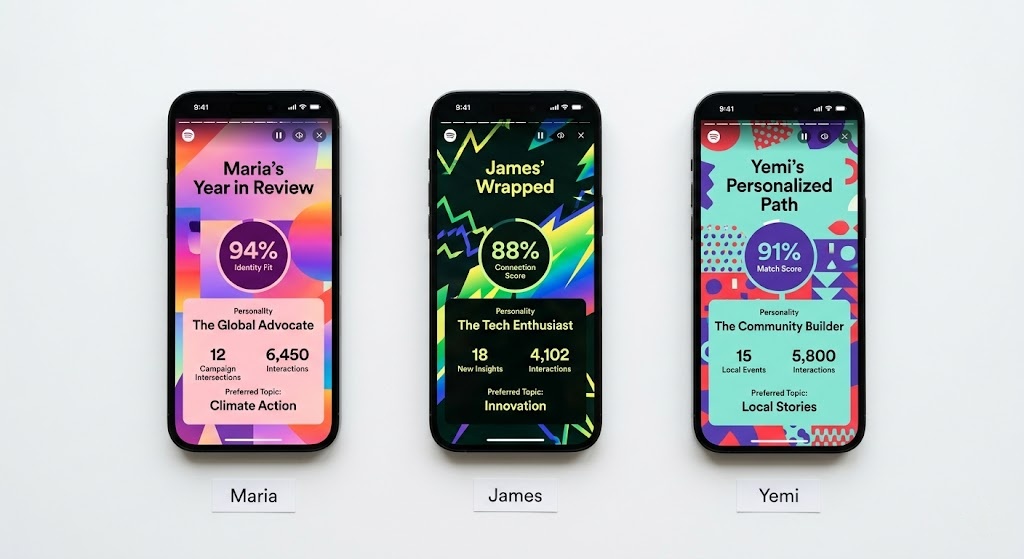
Every December since 2016, Spotify has turned raw listening data into one of the most powerful PR and communications events on the annual calendar. Wrapped is not an advertisement.
There is no call to action, no promo code, no discount. It is simply your data, made beautiful, made shareable, made personal.
That is exactly why it works. Each Wrapped summary is unique to one user. Your top five artists, your total listening minutes, your most-played song at 3 a.m., your personality type as a listener.
No two users see the same report. The experience is designed to make you feel seen, and when you feel seen, you want to share it.
What Spotify Wrapped Teaches in hyper-personalized PR Strategy
Three specific lessons come directly from Wrapped’s model:
- Data is your best storyteller. Spotify does not need to write a press release. The story is already in the data. Every brand generates behavioral data about how customers engage with their products. Using that data to tell individual-level stories is more powerful than any press release format.
- Identity-based sharing drives organic PR. Wrapped works because users share it to show who they are. Your PR campaign needs a shareable identity hook , something that lets audiences self-express through your content. That hook drives earned media that you did not have to pitch.
- Emotional resonance must come before AI. The 2024 Wrapped backlash is instructive. According to brand sentiment analysis published by MediaShower, positive sentiment for Wrapped dropped from 50.5% in 2023 to 41.5% in 2024, and negative sentiment rose from 8.3% to 13.6%.
The reason was clear. Spotify leaned too heavily on AI-generated features like an AI podcast summary and lost the human emotional depth that made Wrapped feel like a personal gift.
Technology should amplify the emotional story, not replace it.
Coca-Cola’s Share a Coke Hyper-personalized PR Campaign
In 2011, Coca-Cola’s marketing director Lucie Austin and creative lead Jeremy Rudge sat in Coca-Cola South Pacific’s Sydney office and wrote a 150-word campaign brief.
The idea was to replace the iconic Coca-Cola logo on bottles with the 250 most common first names in Australia. Give people the chance to find their own name , or the name of someone they love, on a bottle of Coke.
The results in Australia were immediate. Sales rose 7% during the campaign period, according to Coca-Cola’s published data. That reversed years of declining volume in the market.
Encouraged by those numbers, Coca-Cola rolled the campaign out to more than 80 countries.
In the United States, Nielsen data confirmed a 2% increase in soft drink sales at the campaign’s peak in summer 2014.
This is a meaningful gain for one of the world’s largest beverage companies after more than a decade of declining US Coke consumption, according to Wikipedia’s documented campaign history.
Furthermore, the social media effect was dramatic. According to data published by Storybox, more than 500,000 photos were shared using the #ShareACoke hashtag in the first year.
The campaign generated 998 million Twitter impressions. Coca-Cola saw an 870% increase in Facebook traffic during the initial six-month Australian run.
More than 150 million personalized bottles sold globally, and Coca-Cola’s market value increased by $1.8 billion during the campaign’s most successful year.
Lessons from Coca-Cola Teaches on PR Strategy
Three direct takeaways from Share a Coke model:
- The most personal thing you can give someone is recognition. Your name is your identity. Any campaign that makes your audience feel individually recognized, not as a segment, but as a person, will generate organic sharing on a scale. Ask yourself: what is the equivalent of a name for your audience?
- Physical and digital personalization compound each other. The bottle was physical. The sharing was digital. Coca-Cola’s brilliance was designing a campaign that bridged both worlds. Your PR strategy should think about how a personalized offline touchpoint can become viral online content.
- Localization is not translation. Share a Coke did not simply translate the same campaign into different languages. It adapted to local naming conventions, local cultural norms, and local influencer networks.
Real hyper-personalized PR campaign means your message feels native to each market, not just translated.
Starbucks Rewards Hyper-Personalized PR Campaigns
Starbucks Rewards is not traditionally described as a PR campaign. It is a loyalty program.
However, the way Starbucks uses behavioral data to create personalized experiences has become one of the most studied examples of hyper-personalization in modern brand communications, and the PR lessons are direct.
The program uses Starbucks’s proprietary Deep Brew data analytics and AI platform to analyze what each customer orders, when they typically visit, how they respond to different offer formats.
It also showed what seasonal products match their preferences.
Then it sends each loyalty member individually tailored offers, birthday rewards, early access invitations, and reorder prompts, all designed around that specific person’s history.
The results, according to Starbucks’s Q1 2024 earnings call and confirmed by CX Dive, are significant.
Starbucks Rewards reached a record 34.3 million active U.S. members in Q1 2024, up 13% year over year.
According to data compiled by wployalty.net, Rewards members are 5.6 times more likely to visit Starbucks daily than non-members.
The program achieves a 44% customer retention rate, nearly double the industry average of 25%, according to ConnectPOS research.
What Starbucks Teaches Your PR Strategy
The three most actionable lessons from the Starbucks model:
- Build your behavioral data layer first. Before you can personalize, you need data. Start with what you already collects, website visits, email click patterns, event attendance, social media engagement. Those signals tell you what each audience segment cares about, not what you assume they care about.
- Turn your most loyal audience into PR assets. Starbucks’s Gold members are unpaid ambassadors. Your most engaged customers, your repeat readers, your loyal investors, they already believe in your brand. Build campaigns that reward and amplify their advocacy rather than always chasing new audiences.
- Personalization must produce real value, not just the appearance of it. A birthday message with a free drink is worth something.
A generic ‘we value you’ email is not. Every Hyper-Personalized PR touchpoint in your PR program should deliver something the audience could not get from a mass communication.
This means doing the work to understand what each segment values.

How to Build Hyper-Personalized PR Campaigns for Your Brand in 2026
You do not need Spotify’s engineering team, Coca-Cola’s distribution network, or Starbucks’s AI platform to run a hyper-personalized PR campaign.
What you need is a clear process and the discipline to follow it. Here is a four-step framework built on what the three case studies above actually did:
1. Build Audience Profiles That Go Beyond Demographics
Demographics, age, location, job title, tell you who someone is on paper.
They do not tell you what someone cares about this week, what frustrates them about your industry, or what kind of story would make them stop scrolling and pay attention.
Consequently, your audience profiles need to go deeper.
Use behavioral data from your website, your CRM, and your social media analytics. Study what content your target journalists have published in the past 60 days.
Review what your investors have asked about on recent earnings calls. Look at what your customers are searching for on Google before they reach your site.
That behavioral layer is the foundation of every hyper-personalized campaign that works.
Specifically, build separate profiles for each major audience group:
- Media contacts: sorted by beat, recent coverage topics, tone preference, and outlet reach.
- Investors and analysts: sorted by portfolio focus, the questions they have raised publicly, and the metrics they cite most often.
- Customers and end users: sorted by product use behavior, lifetime value, engagement frequency, and communication channel preference.
- Policymakers and regulators: sorted by committee focus, stated policy priorities, and constituent demographics.
2. Design a Message That Adapts Without Losing Consistency
Hyper-personalization does not mean telling a different story to every audience. It means telling the same core story in a way that is shaped by what each audience already cares about.
Coca-Cola’s core story across Share a Coke was always about sharing joy and human connection.
But the names on the bottles, the influencer partnerships, and the local activations made it feel like they were native to each market.
Start with your brand narrative, the one true thing about your organization that you want every audience to understand.
Then build a message matrix that shows how that narrative connects to each specific audience’s priorities. For example:
- Your product launch story to a TechCrunch journalist might focus on the engineering innovation behind the product.
- The same story to a Forbes contributor might focus on the market problem your product solves and the revenue opportunity.
- The same story to a potential enterprise customer might focus on the time and cost savings your product delivers.
- The same story to an investor might focus on the unit economics and the total addressable market.
Each message is different, true, and personalized to what that specific audience cares most about.
3. Match Your Channel to Your Audience Behavior
Precision in channel selection is as important as precision in message design.
Spotify Wrapped understood that its audience shared their results on social media platforms, and designed the campaign with native social sharing built in from the start.
Starbucks knew its loyalty members engaged most through the mobile app, and built every personalized communication around the app experience.
For your PR campaign, match each message to the channel where that audience is most receptive.
A 35-year-old financial journalist who checks Twitter 40 times a day needs a very different approach than a 52-year-old institutional investor who reads three email newsletters each morning.
A social media manager at a consumer brand wants creative brief and visual assets. A policy director at a federal agency wants a one-page research summary with citations.
Additionally, think about timing. Starbucks’s Deep Brew platform identified not just what cohort a customer belonged to, but when that customer was most likely to act on a personalized offer.
Your media pitches should follow the same logic. A news-hook pitch works best within the first two hours of a breaking story.
A thought leadership pitch works best on Tuesday or Wednesday morning, not Friday afternoon.
4. Measure Response at the Individual Level and Adjust in Real Time
The difference between personalization and hyper-personalization is feedback. Standard personalization sets up segments and sends the same message to everyone in that segment for six months.
Hyper-personalization monitors how each individual responds and adjusts the message, the timing, and the channel based on that response.
For your PR team, this means:
- Tracking which journalists respond to which types of pitches and adjusting your approach for each contact individually.
- Monitoring which pieces of thought leadership content generate the most investor inquiries and building more of that type of content.
- Watching which earned media placements drives the most website traffic from which audience segments and feeding that insight back into your pitching strategy.
- Testing different message formats with different media segments before committing to a full campaign rollout
The 63% growth Bliss Group achieved over three years, cited by PRovoke Media in their profile of the agency, was built partly on exactly this kind of data-informed feedback loop.
The firm invested in proprietary tools including Pitch PRfect and Audience Architecture to sharpen how they matched client messages to media targets.
Those tools are not magic, they are structured applications of the same feedback principle that Spotify and Starbucks use at consumer scale.
Also Read: Media Fragmentation PR: Bold Strategies That Drive Results
What the Tailored Narratives PR Trend Means for Your Agency Selection
If you are evaluating PR agencies, the hyper-personalization trend changes what you should look for. A firm that sends 500 generic pitches and calls it a campaign is not built for this moment.
You need an agency that can demonstrate three specific capabilities:
- Data infrastructure: does the firm have tools to analyze audience behavior at the individual level? Ask specifically about their media database, their CRM practices, and how they track which pitches generate coverage by journalists.
- Message architecture: can they build a single brand narrative that adapts to multiple audience segments without losing consistency? Ask to see examples of how they have positioned the same client story differently for consumer media versus trade media versus investor audiences.
- Real-time feedback loops: do they adjust campaigns based on response data during the campaign, or only in the retrospective debrief? Ask how often they report engagement metrics and how they use those metrics to change strategy mid-campaign.
The firms that can answer all three questions with specific examples — not vague claims — are the ones building for where PR is heading.
The firms that cannot still operate on a model that was already becoming obsolete before 2025.