This Gregory PR agency case study examines how the firm approaches B2B PR thought leadership for complex, regulated, and highly competitive industries.
Most B2B companies struggle with the same problem. They have smart executives, real expertise, and strong products.
But the right journalists, investors, and enterprise buyers have never heard of them. The gap between expertise and visibility is exactly where Gregory PR agency built its business.
This piece covers three real client stories, GraniteShares, SHI International, and Customized Energy Solutions, to show how Gregory’s approach works in practice.
It also looks at where the agency is strongest, where it has limitations, and whether the B2B PR, thought leadership Gregory agency model, is the right fit for your business.
You will find specific results here, not vague claims. The numbers come from publicly available Gregory case studies and third-party industry directories, so you can verify them yourself.

Gregory PR Agency Case Study Background
Gregory is a 35-year-old PR and communications agency with offices in New York, Boston, Philadelphia, and London.
According to O’Dwyer’s PR Firms Directory, the agency has 122 full-time professionals and ranks as the 38th largest PR firm in the United States.
The firm has deep expertise in financial services, technology, cybersecurity, supply chain and logistics, real estate, education, and healthcare.
More than 20% of the Gregory team has worked in the media.
That includes former producers from Fox News and Good Morning America, as well as reporters from Money, The New York Times, and Barron’s.
This journalism history shapes how the agency builds leadership programs.
Gregory works with B2B brands that need to reach institutional audiences: investors, enterprise buyers, industry analysts, and regulators.
Consumer PR is not the agency’s focus. If you run a consumer brand, this is not the case study or the agency for you.
B2B PR Thought Leadership Gregory Agency Case Study
GraniteShares ETF Launch
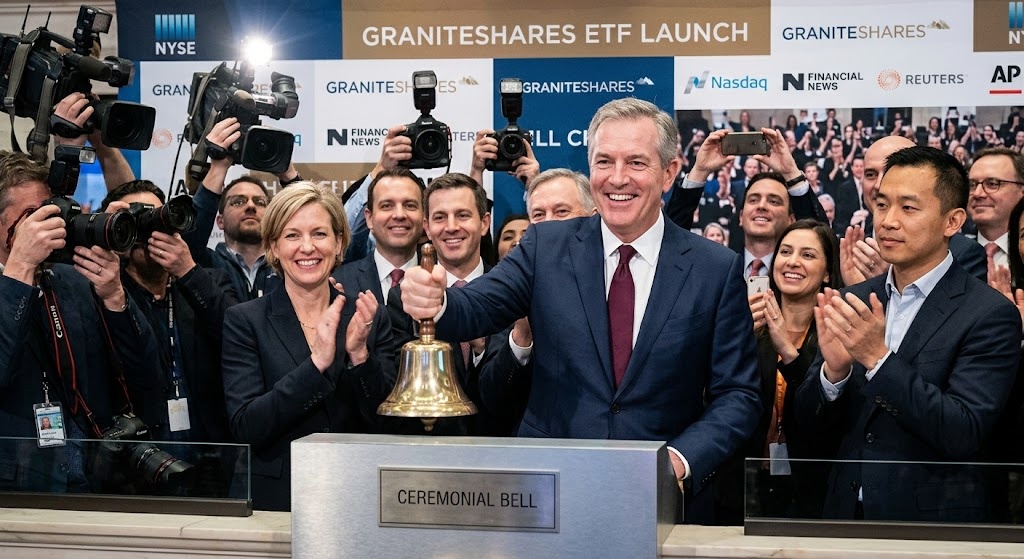
The GraniteShares case study is one of the most instructive examples of Gregory PR agency. In 2017, GraniteShares hired Gregory to support the launch of a new commodity-focused ETF.
At the time, GraniteShares had no market visibility, no brand awareness, and no history. It was entering a saturated market dominated by established ETF providers.
The challenge was not just building awareness. GraniteShares needed its CEO, Will Rhind, as a credible voice in a competitive space where scale and history matter. Gregory developed a two-part strategy:
- Short-term news-cycle tactics: matching GraniteShares experts to daily commodity and ETF news stories for fast, reactive media placement
- Long-term brand narrative: building feature coverage around GraniteShares’ startup story and its CEO’s entrepreneurial journey.
Gregory used in-person media tours, major industry conferences, and product milestones, like new ETF launches, bell-ringing events, and AUM growth announcements, as story anchors.
The team also produced video content to amplify thought leadership across digital platforms.
GraniteShares Results
According to Gregory’s published case study, the campaign delivered:
- More than 1,000 media appearances over the course of the engagement
- Coverage in Forbes, The Associated Press, The Wall Street Journal, Bloomberg, Entrepreneur, CNBC, and Fox Business
- Granite Shares grew to more than $800 million in assets under management across its ETF suite.
Those are significant outcomes for a brand that started with zero visibility. The coverage in top-tier financial and business media gave GraniteShares the institutional credibility it needed to compete with larger, established ETF providers.
GraniteShares is now a recognized voice in commodity and ETF investing, a positioning that directly supports sales and investor confidence.
This case study shows the specific type of client Gregory serves best.
A B2B or institutional brand with genuine expertise, entering a competitive market that needs media credibility to differentiate from larger competitors.
SHI International Content Strategy
The SHI International case study shows a different dimension of Gregory’s B2B PR thought leadership model. SHI is now a more than $10 billion sales organization and enterprise technology solutions provider.
It is Microsoft’s biggest partner and the largest minority and female-owned company in the United States.
When SHI first engaged Gregory, it was still building its brand visibility and trying to establish thought leadership in the enterprise IT space.
Gregory modeled the engagement on a newsroom approach. The agency worked with SHI’s internal team to build a content platform that published articles addressing the specific challenges faced by IT directors, executives, and practitioners who buy from SHI.
Additionally, Gregory conducted monthly editorial calls to plan content, then interviewed SHI experts and translated their knowledge into accessible, audience-specific posts.
Read Also: Regan Communications Review: Dominant Boston Public Affairs
SHI Outcomes and Business Impact
The SHI program delivered business results that went beyond media coverage. According to Gregory’s published case study, outcomes included:
- A steady, measurable increase in website traffic driven by content marketing.
- A content library that SHI sales teams used as a touchpoint tool with prospects and clients.
- Sales staff reported closing deals, sometimes exceeding $1 million – using SHI blog content to trigger and advance conversations.
Most PR programs measure success in media placements and brand impressions. Gregory’s SHI work moved the needle on sales conversations and pipeline activity.
The SHI case study also illustrates an important principle. Thought leadership does not have to live only in earned media.
When done well, it becomes a sales asset that your team uses in direct conversations with prospects.
Customized Energy Solutions
The Customized Energy Solutions (CES) case study shows how Gregory builds credibility for B2B companies that serve technical, regulated industries.
CES is an energy consulting and advisory firm with a deep bench of subject matter experts.
When they engaged Gregory, they needed to move from relative obscurity to being a go-to media resource in the energy sector.
Gregory’s approach followed a clear pattern. First, the team mapped CES experts to specific, trending topics, power shortages caused by extreme weather, Bitcoin mining and energy consumption, energy policy debates.
Secondly, Gregory matched those experts to live news stories where their perspective would add genuine value for journalists.
Additionally, the team developed original thought leadership content to expand coverage beyond reactive media opportunities.
The result, according to Gregory’s published case study, was that CES became a standing resource for energy journalists.
Media contacts now reach out to Gregory proactively, seeking CES perspectives on breaking stories.
That shift, from agency pitching journalists to journalists seeking out clients, is the gold standard for B2B thought leadership programs.
Gregory PR Agency Strenghts
Across these three case studies and the agency’s broader portfolio, several consistent strengths emerge:
- Journalism-informed pitching: with 20-plus percent of staff coming from media backgrounds, Gregory’s pitches land because they are built around how journalists work.
- Industry specialization: the agency does not try to serve every market. Its verticals are financial services, technology, cybersecurity, supply chain, real estate, education, and healthcare. Depth beats breadth for B2B credibility.
- Content as a business asset: Gregory builds thought leadership programs that function as sales tools, not just media tools. That distinction matters for B2B clients with long sales cycles.
- News-cycle responsiveness is designed to respond quickly to breaking news and insert client voices into live conversations. That responsiveness drives earned media volume.
- Long-term relationship orientation : the Kimco Realty partnership has been running for a decade. That kind of tenure suggests the agency builds programs that clients find genuinely valuable over time.
Client feedback quoted on the agency’s site describes Gregory as ‘an essential member of our team’ who ‘understand the industry’ and whose ‘connections are not merely extensive but strategic.’
Gregory Agency Limitations and Gaps
An honest case study analysis also identifies where Gregory may not be the best fit.
- Consumer PR: Gregory is a B2B firm. If you sell to consumers, want lifestyle media placements, or need influencer campaigns, Gregory is not designed for that work.
- Small brand budgets: the agency serves ‘a blue-chip portfolio of global brands,’ according to O’Dwyer’s. Startups or very early-stage companies may not get senior team attention at this firm.
- Creative brand campaigns: Gregory’s strength is credibility-building through journalism-informed storytelling. It is not primarily a creative brand campaign agency. If you need a brand identity overhaul or a splashy consumer launch, you may need a different kind of partner.
- Independent review data: like many B2B agencies, Gregory does not have a large body of publicly available third-party reviews.
Most performance evidence comes from the agency’s own published case studies. You should request client references independently.
As AI and digital content continue to reshape B2B media, you should ask specifically how Gregory integrates AI-driven content distribution and AI search optimization into its programs.
The agency references using AI tools in its O’Dwyer’s profile, but the specifics are worth probing in any initial conversation.

Is Gregory the Right B2B PR Thought Leadership Agency for You?
Gregory takes B2B brands with genuine expertise and puts them in front of the journalists, analysts, and institutional audiences that matter.
The GraniteShares story, zero to 1,000 media appearances and $800 million in AUM, is not a one-off. The SHI and CES results follow the same pattern.
The B2B PR thought leadership Gregory agency model works best when three conditions are met. First, your brand has genuine expertise that a journalist would find credible and quotable.
Secondly, you operate in one of Gregory’s core verticals, finance, tech, supply chain, energy, healthcare, or real estate.
Also, you are committed to a long-term program rather than a single campaign launch.
If those three conditions describe your business, Gregory can be a consideration.
If your business is consumer-facing, lifestyle-focused, or looking for a quick-turn campaign, this is not the right match.
Either way, use the case study evidence here as a starting point. Request Gregory’s full client references in your specific industry.
Ask specifically about their reporting process and how they measure thought leadership against your business goals.
The right PR agency is the one that fits your actual situation, not just the one with the most impressive media logos on its website.
Frequently Asked Questions
What industries does Gregory PR serve?
Gregory specializes in financial services, technology, cybersecurity, supply chain and logistics, real estate, education, and healthcare. It focuses on B2B and institutional clients rather than consumer brands.
How big is Gregory PR as an agency?
According to O’Dwyer’s PR Firms Directory, Gregory has 122 full-time professionals and ranks as the 38th largest PR firm in the United States. The agency has offices in New York, Boston, Philadelphia, and London.
What results did Gregory achieve for GraniteShares?
Gregory delivered more than 1,000 media appearances in outlets including Forbes, The Wall Street Journal, Bloomberg, CNBC, and Fox Business. GraniteShares grew to more than $800 million in ETF assets under management during the engagement. These figures are from Gregory’s published case study.
Is Gregory PR good for startups?
Gregory can work for well-funded B2B startups with genuine expertise in its core verticals — particularly fintech, energy, cybersecurity, or enterprise tech. However, very early-stage companies with limited budgets may struggle to get dedicated senior attention at a firm of Gregory’s size and client portfolio.
How does Gregory measure thought leadership success?
Gregory measures through a combination of earned media volume, outlet quality, executive visibility, and increasingly, business impact metrics like website traffic and sales pipeline support. The agency provides clients with monthly reports and 24/7 access to a real-time media tracker, according to the agency’s website.